App Development Cost in Dubai (2026): What a Mobile App Really Costs
Building an app in Dubai can cost AED 25,000 or AED 2,500,000, and both numbers are "correct" for someone. The gap isn't builders overcharging. It's that an "app" can mean a lean first version or a full platform, and most quotes never say which one they priced. Here's how to work out which you actually need, what it should cost in this market, and what the proposal left out.
The short answer
- A first version (MVP) in Dubai realistically costs AED 25,000 to 90,000 and takes 6 to 10 weeks. A full product is AED 90,000 to 300,000 over 3 to 6 months.
- The build price is roughly half the real first-year number. Budget 15 to 25% of the build cost per year for maintenance. Total cost of ownership lands around 1.5 to 2× the build.
- Cross-platform saves 25 to 45% versus building iOS and Android natively, and is the right default for nearly every business app.
- The backend is usually the biggest line: and it's invisible, which is exactly why cheap quotes cut it first.
- A single mid-level developer on a Dubai payroll costs more per year than most complete MVP builds. The hiring maths is worth ten minutes before you commit to a team.
The ballpark, honestly
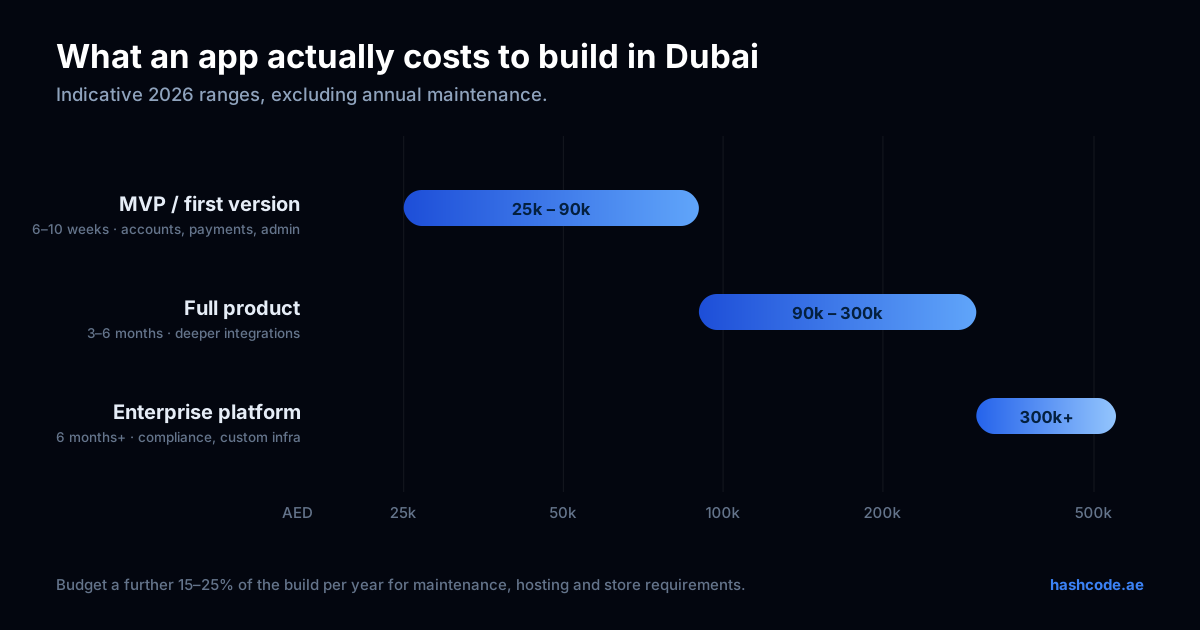
| Item | Cost (AED) | Timeline | What you get |
|---|---|---|---|
| MVP / first version | 25,000 to 90,000 | 6 to 10 weeks | The core of your idea, 15 to 25 screens, real accounts, payments, a basic admin panel, a few integrations |
| Full product | 90,000 to 300,000 | 3 to 6 months | A polished app, more features, deeper integrations, the pieces a growing business needs |
| Enterprise platform | 300,000+ | 6 months+ | Multi-role systems, heavy integrations, custom infrastructure, strict compliance |
| Annual maintenance | 15 to 25% of build | Ongoing | Hosting, OS updates, store requirements, fixes, small features |
For most Dubai businesses building their first serious app, the realistic app making cost in Dubai starts at AED 25,000 to 90,000. If someone quotes far below that for a real product with accounts and payments, be curious about what's missing. The answer is usually the backend, QA, or app store submission.
What different types of app cost in Dubai
The tier tells you the size of the project. The type of app tells you which tier you are in. These are the apps Dubai businesses ask us about most often, priced for iPhone and Android together with a working admin panel:
| Type of app | Cost (AED) | Timeline | What drives the price |
|---|---|---|---|
| Simple brochure, loyalty or catalogue app | 10,000 to 40,000 | 3 to 6 weeks | Mostly content. Cheap unless it needs accounts or payments |
| Booking app (clinic, salon, car service, classes) | 35,000 to 90,000 | 6 to 10 weeks | Calendars, reminders, payments and staff schedules |
| E-commerce app with payments and delivery | 50,000 to 150,000 | 2 to 4 months | Catalogue sync, checkout, cash on delivery, Tabby or Tamara, order tracking |
| Marketplace (property, car rental, services) | 90,000 to 300,000 | 3 to 6 months | Two sides of users, listings, commissions, payouts and disputes |
| Food delivery or on-demand (customer, driver and admin apps) | 120,000 to 300,000 | 4 to 6 months | Three apps instead of one, live tracking, dispatch logic |
| Fintech, health or anything regulated | 300,000+ | 6 months+ | Security reviews, compliance, audit trails, licensed integrations |
"An app like Talabat" or "an app like Careem" usually means the bottom of the on-demand row for a focused first version, not the platform those companies run today. Their apps are the result of years of work by large teams. Yours needs the core loop that proves customers will use it.
Why Dubai quotes vary so wildly
Dubai has an unusually wide supplier spread: global enterprise consultancies, established local agencies, small studios, and offshore teams billing at a fraction of local rates all quote the same brief. That's the main reason you'll see AED 15,000 and AED 400,000 for what sounds like the same app. The price differences are real, but they mostly reflect three things:
- Who actually writes the code, and where. A Dubai-managed project built by a distributed team costs less than an all-onshore team and more than a pure offshore shop. All three can be fine, but you should know which one you're buying.
- How much of the eleven-part scope is included. A complete mobile development service covers discovery, UX, UI, mobile build, backend, integrations, QA, store submission, analytics, handover and support. Cheap quotes price four of them.
- Whether anyone owns month 13. A build-and-vanish quote is genuinely cheaper than a build-and-maintain quote. It's also how apps quietly stop working.
The cost nobody warns you about: year one
The build price is not the total. Across the first year, maintenance, hosting, updates, fixes, and small features, expect true cost of ownership to land around 1.5 to 2× the initial build. A useful rule: budget 15 to 25% of the build cost per year for ongoing maintenance. An app is a product you run, not a thing you buy once, and Apple and Google both raise their minimum requirements annually. An app nobody maintains eventually can't be installed at all.
What drives the number
Features and screens
Every screen and every feature is design plus build plus testing. The fastest way to blow a budget is to insist on everything in version one. The fastest way to save is to cut ruthlessly to the core.
One platform or two?
Building iOS and Android natively means building twice. A cross-platform approach (one codebase for both) typically saves 25 to 45% and makes maintenance simpler, which is why we usually recommend it unless you have a specific reason not to. Worth knowing for this market: Android runs roughly 78% of mobile traffic in the UAE while iOS users tend to spend more per head, so covering both is normally the right call rather than picking a side.
The backend
The part users never see, accounts, data, payments, admin, integrations, is often the bulk of the work. A pretty screen on top of no backend is cheap and useless; the engine room is where the cost and the value sit. When two quotes differ by half, this is usually the difference.
Payments, compliance, and integrations
Taking payments, meeting UAE data rules (PDPL), and connecting to other services all add real, worthwhile cost. In Dubai specifically, budget for the things global cost guides never mention: Arabic and right-to-left support designed in from the start rather than retrofitted, local payment gateways, cash on delivery if you're selling physical goods, Tabby or Tamara instalments, WhatsApp as a primary channel rather than an afterthought, and UAE Pass integration if you're touching anything government-adjacent. Each is modest on its own; together they are a meaningful share of a Dubai build, and they are exactly what a cheap quote leaves out.
Compare quotes on the exclusions list, not the total. Two numbers that differ by half are almost always two different projects.
How to spend less without regretting it
- 1Start with an MVP. Build the smallest version that proves the idea, get it in front of real users in 6 to 10 weeks, then reinvest what you learn (and earn) into the bigger build. This is the single best way to avoid wasting money on features nobody wanted.
- 2Go cross-platform unless you have a hard reason not to, one codebase, two app stores.
- 3Cut scope, not quality. Fewer features built properly beats many features built badly.
- 4Own your code. Make sure the app, its repository and the developer accounts are in your company's name, so you're free to change who works on it later.
- 5Budget for year one, not just launch day. Maintenance is part of the price of having an app at all.
- 6Ask for the exclusions list in writing. It tells you more about a quote than the price does.
How we approach it
One more thing worth checking before you commit: if you've been weighing up hiring your own team instead, compare these numbers against what it costs to hire mobile app developers in Dubai, a single mid-level developer usually costs more per year than this entire build. As a mobile app development company in Dubai, we build iPhone and Android apps from a first MVP up to full platforms, alongside web software for businesses across Dubai, and we help you cut scope to the version worth building first. We've taken products from idea to production and kept running them. You can see the kind of thing we build in our case studies. When we quote, we scope the smallest thing that delivers real value, so you're not paying to find out whether the idea works.
Get a real estimate for your app
Tell us what you want to build. We'll help you scope an MVP and give you an honest range, reply within one business day.
Talk to usFrequently asked questions
How much does app development cost in Dubai?
A first version (MVP) with real accounts, payments and a basic admin panel typically costs AED 25,000 to 90,000 and takes 6 to 10 weeks. A full product runs AED 90,000 to 300,000 over 3 to 6 months, and an enterprise platform starts around AED 300,000. Add 15 to 25% of the build cost per year for maintenance.
How much does it cost to make a mobile app in Dubai?
For most Dubai businesses the realistic starting point is AED 25,000 to 90,000 for a first version covering the core of the idea. Simple, single-purpose apps can start lower, around AED 10,000 to 40,000. Quotes far below that for an app with accounts and payments have usually excluded the backend, QA on real devices, or app store submission.
How much does an app like Talabat or Careem cost to build in Dubai?
A focused first version of an on-demand app, with a customer app, a driver or provider app and an admin panel, typically costs AED 120,000 to 300,000 and takes 4 to 6 months. That buys the core ordering, dispatch and tracking loop, not the full platform those companies have built over many years.
Why do app development quotes in Dubai vary so much?
Because Dubai has an unusually wide supplier spread, global consultancies, local agencies, small studios and offshore teams all quote the same brief. Beyond rates, the gap comes from scope: how deep the backend goes, whether a usable admin panel is included, QA on real low-end devices, app store submission and rejection handling, Arabic and right-to-left support, and whether anyone maintains the app after launch. Ask each supplier for an explicit exclusions list.
Is it cheaper to build for iOS and Android at the same time?
Yes, usually. A cross-platform approach uses one codebase for both platforms and typically saves 25 to 45% versus building each natively, with simpler ongoing maintenance. In the UAE this matters because Android carries roughly 78% of mobile traffic while iOS users spend more per head, so most businesses need both stores rather than one.
What's the ongoing cost after launch?
Budget around 15 to 25% of the build cost per year for maintenance, updates and fixes. Across the first year, total cost of ownership is often 1.5 to 2× the initial build once hosting and small features are included. Apple and Google both enforce annual minimum requirements, so an unmaintained app eventually stops being installable.
Is app development cheaper elsewhere in the UAE than in Dubai?
Somewhat, but less than people expect. Rates in Sharjah, Ajman and the northern emirates run below Dubai agency pricing, and free-zone based teams often quote lower while serving Dubai clients directly. The larger variable is scope and delivery model rather than the emirate on the invoice, the same brief quoted as an MVP versus a full product will differ far more than the same brief quoted in two emirates.
- Software Development
- Mobile Apps
- Pricing
- Dubai
- UAE
Keep reading
Have a project in mind?
We build AI, automation, and software, and run it in production. Tell us what you're trying to do.
Start your project