Shopify Custom Development in Dubai: Costs and When You Need It
Shopify is deliberately opinionated, and that is why it works. You get a checkout that converts, hosting that does not fall over on sale day, and PCI compliance you never think about. Then your business does something Shopify did not anticipate: a rental model, a wholesale price list per customer, an ERP in Dubai that needs stock in real time, or Arabic that has to read right to left properly. That is where custom development starts. This guide covers what each option costs in Dubai, how long it takes, and which one your store actually needs.
The short answer
- "Custom Shopify development" covers four very different things: theme customisation, a custom app, integrations, and headless. They differ in cost by a factor of twenty.
- Start by exhausting the app store. If a AED 150/month app does 90% of it, buy the app, custom work should solve what nothing else can.
- Custom apps are the sweet spot for most growing stores: AED 15,000 to 60,000 to make Shopify behave the way your business actually works.
- Headless is not an upgrade. It buys you front-end freedom and costs you the Shopify conveniences that made you choose it, only worth it for specific, provable reasons.
- If you sell in the UAE, the work nobody quotes for, Arabic RTL, cash on delivery, Tabby/Tamara, local couriers, VAT-compliant invoices, is where most stores actually need help.
The four kinds of Shopify custom development
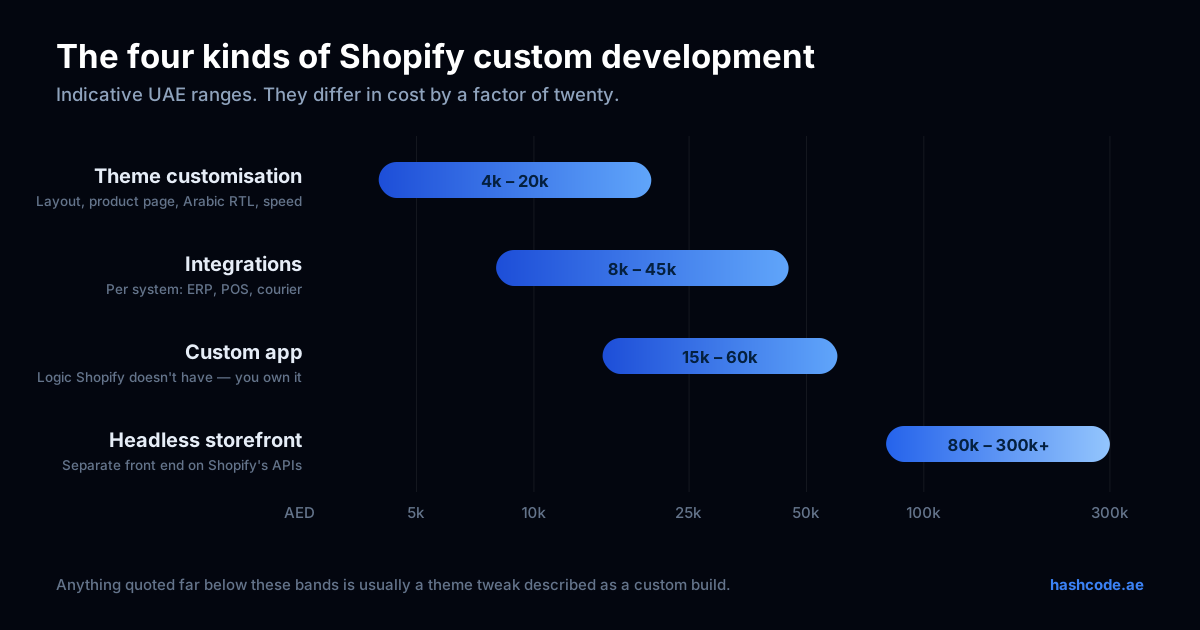
| Type | What it is | Typical cost | Good fit when |
|---|---|---|---|
| Theme customisation | Editing Liquid, CSS and JS in your theme, layout, product page, Arabic RTL, speed | AED 4,000 to 20,000 | The store works, it just doesn't look or read the way it should |
| Custom app (private) | A small application you own, extending Shopify through its APIs and admin | AED 15,000 to 60,000 | You need logic Shopify doesn't have, pricing rules, subscriptions, custom workflows |
| Integrations | Connecting Shopify to your ERP, POS, accounting, courier or WhatsApp | AED 8,000 to 45,000 per system | Someone is retyping orders into another system every day |
| Headless / custom storefront | A separately built front end talking to Shopify's APIs, with Shopify handling checkout | AED 80,000 to 300,000+ | You have genuine performance, design or multi-brand requirements a theme can't meet |
Before you build anything: exhaust the app store
This is unglamorous advice from people who make money building things, so take it seriously. Shopify's app ecosystem is enormous, and for the vast majority of requirements there is already an app at AED 100 to 400 a month that does most of the job. A custom build only makes sense when one of these is true:
- Nothing does it. Your requirement is specific to how your business operates, which is often a good sign. It means it's part of your advantage.
- You'd need five apps to do it. Stacked apps slow the store down, conflict with each other, and quietly cost more than the build would have.
- The app exists but can't reach your systems. Most apps integrate with popular Western tools, not your regional ERP or in-house stock system.
- The subscription has outgrown the build. An app at AED 1,200/month is AED 43,000 over three years. Compare that against building it once and owning it.
What custom apps actually get used for
The requests we see repeat. Almost all of them are a business model that doesn't fit the shape of a normal product-and-cart store:
- Customer-specific pricing: wholesale tiers, contract rates, or B2B accounts that must never see retail prices.
- Made-to-order and configurable products: dimensions, engraving, fabric, fitting, where the price is calculated rather than listed.
- Rental and booking models: date ranges, availability, deposits and returns, which a standard cart has no concept of.
- Operational automation: routing orders to the right warehouse, generating delivery notes, syncing stock across a store and three retail branches.
- Loyalty and referral logic specific to how you reward customers, rather than what a generic app allows.
A private app is the right container for all of these. It lives in your Shopify admin, uses Shopify's APIs, survives theme updates, and, importantly, belongs to you rather than to a vendor who can change their pricing next quarter.
The headless question, answered honestly
Headless means building your own storefront and using Shopify purely as the commerce engine behind it. It's the most requested and least justified item on this list. Agencies love it because it's a large project; it is genuinely right for a minority of stores.
Good reasons: you're running several brands or regions off one catalogue; your content needs are far beyond what a theme can express; you have measured, specific performance requirements that theme optimisation can't reach; or your storefront must be embedded inside a larger product you already run. Bad reasons: "it's faster" (a well-built theme on Shopify's CDN is already fast), "it's more modern", or "our competitor did it".
What you give up is real: theme editing for your marketing team, many app integrations that expect a standard storefront, and a maintenance burden that is now yours forever. Budget three to five times a theme build, plus ongoing engineering. Choose it deliberately or not at all.
The best Shopify build is the smallest amount of custom code that makes the platform fit your business, and not one line more.
How long each type actually takes
Cost gets quoted; timeline gets assumed. These are realistic elapsed times including your review cycles, which are usually the slowest part. A build waiting three days for feedback is a build that takes three days longer.
| Type | Elapsed time | What sets the pace |
|---|---|---|
| Theme customisation | 1 to 3 weeks | Design approval, and how much of the theme is being touched |
| Custom app (private) | 4 to 10 weeks | How much business logic it holds, and how clearly you can describe the rules |
| Integration (per system) | 2 to 6 weeks | The other system's API quality. This is the single biggest variable, and it's rarely yours |
| Headless storefront | 3 to 6 months | Design, content modelling, and rebuilding everything a theme gave you for free |
The integration row deserves emphasis. Connecting Shopify to a modern SaaS tool with good documentation is a fortnight. Connecting it to an on-premise ERP that a contractor configured in 2014 and nobody has documented since can take two months, most of it spent finding out what the system actually does. If your project depends on an integration, ask your partner to spend a day investigating that system before fixing a price. A supplier who quotes a firm number for an undocumented integration without looking at it is either padding heavily or about to discover a problem at your expense.
Do you need Shopify Plus?
Usually not, and it's worth being clear about why, because it comes up in almost every scoping conversation. Plus is roughly ten times the monthly cost of the standard plans, and most of what people buy it for turns out not to be what they needed.
- Good reasons: checkout customisation beyond what standard plans allow, genuinely high order volume, multiple storefronts or regions under one organisation, B2B wholesale channels, or contractual requirements around uptime and support.
- Bad reasons: "we're growing", wanting a discount on transaction fees that doesn't yet outweigh the subscription, or a partner who earns more when you're on Plus.
- Do the arithmetic first. Plus starts making commercial sense at a level of monthly revenue your accountant can identify precisely. Until then the subscription buys capability you aren't using.
If you're moving to Shopify from something else
Replatforming is its own project, and the custom development is often the smaller half of it. The parts that go wrong are rarely technical:
- 1URL mapping. Every product and category URL on the old store needs a 301 redirect to its new home. Skip this and you lose the search rankings you spent years earning, the single most expensive mistake in a migration, and the easiest to avoid.
- 2Data quality. Migration is when you discover your product data has three spellings of the same brand. Clean it before it moves, not after.
- 3Customer accounts and passwords. Passwords cannot be migrated. Customers must reset, so plan the communication rather than letting people discover it at checkout.
- 4Order history. Decide early whether it comes across, stays in the old system, or lives in your ERP. All three are valid; discovering the decision late is not.
- 5Launch timing. Not during your peak season, and not on a Thursday afternoon before a long weekend.
The UAE parts of a Shopify store nobody quotes for
Most Shopify guidance is written for the US market. These are the pieces that decide whether a UAE store converts, and they're where a large share of our Shopify work actually goes:
- 1Arabic, done properly. Not just translated strings, right-to-left layout, correct typography, mirrored icons and a language switcher that doesn't lose the cart. Half-done Arabic reads worse than none.
- 2Cash on delivery. Still a meaningful share of UAE orders, and it needs real handling: COD fees, order verification to cut fake orders, and a courier flow that reconciles collected cash.
- 3Buy now, pay later. Tabby and Tamara are close to table stakes in this market, and the messaging needs to appear on the product page, not just at checkout. That's where it lifts conversion.
- 4Local payment and VAT. Regional gateways, plus tax-compliant invoices that satisfy a UAE business customer's accountant.
- 5Courier integrations. Automatic label creation and tracking with the couriers you actually use, so nobody is copying addresses into a portal.
- 6WhatsApp, everywhere. Abandoned-cart recovery, order updates and support on the channel your customers actually read. Ours ties into WhatsApp automation rather than a bare chat button.
How to brief it so you don't overpay
- 1Describe the outcome, not the feature. "Wholesale customers must see their own prices and pay on 30-day terms" gets you a good solution. "Build a custom pricing app" gets you the thing you asked for, whether or not it was needed.
- 2Ask what's off the shelf first. A partner who tells you an app already does it is worth keeping.
- 3Insist the custom app is yours. Your Shopify org, your repository, your API keys. Some agencies keep the app in their partner account, which means it leaves when they do.
- 4Get theme changes version-controlled. Untracked edits made straight in the live theme are how stores break on a Friday night.
- 5Agree what happens at Shopify's next platform change. Shopify deprecates APIs on a schedule. Someone needs to own that, in writing.
How we work on Shopify
We do the custom half: apps, integrations and the operational plumbing that makes a store fit the business behind it. We'll start by telling you which parts of your request Shopify or an existing app already handles, that conversation costs you nothing and usually shrinks the project. Then we build the rest properly, hand it over in your accounts, and keep it running as Shopify's platform moves. If you need the whole store built, not just the custom parts, see our ecommerce website development service. If you're weighing Shopify against a different platform or a custom build entirely, read our guide to what an ecommerce website costs in Dubai first, and see the sort of thing we ship in our case studies.
Tell us what your store can't do yet
Describe the thing Shopify won't let you do. We'll tell you whether it's an app, a build, or something you already have, with a real number, within one business day.
Ask about your storeFrequently asked questions
What is Shopify custom development?
It covers four different things: customising your theme's Liquid, CSS and JavaScript; building a private Shopify app that adds logic the platform doesn't have; integrating Shopify with other systems such as an ERP, POS or courier; and building a headless storefront that uses Shopify only as the commerce engine. Costs range from a few thousand dirhams for theme work to several hundred thousand for headless.
How much does a custom Shopify app cost?
A private Shopify app for a growing UAE store typically costs AED 15,000 to 60,000, depending on how much business logic it holds and how many systems it touches. Integrations with an external system usually run AED 8,000 to 45,000 each. Simple theme customisation is far less, usually AED 4,000 to 20,000.
Should I go headless with Shopify?
Usually not. Headless is justified when you run multiple brands or regions off one catalogue, have content or performance requirements a theme genuinely cannot meet, or need the storefront embedded in a larger product. It costs three to five times a theme build, removes theme editing from your marketing team, breaks compatibility with many apps, and makes maintenance permanently yours.
Can Shopify handle Arabic and right-to-left properly?
Yes, but not by default and not well through translation apps alone. Doing it properly means right-to-left layout, correct Arabic typography, mirrored icons and directional elements, and a language switcher that preserves the cart and checkout state. It's theme-level work, and it's one of the most common Shopify jobs we do for UAE brands.
Is a custom build better than buying a Shopify app?
No, buy the app whenever one exists that does the job. Custom development is worth it when nothing does what you need, when you'd otherwise stack five conflicting apps, when the app can't reach your own systems, or when subscription costs have overtaken what building it once would have cost.
How long does custom Shopify development take?
Theme customisation runs 1 to 3 weeks, a private custom app 4 to 10 weeks, an integration with another system 2 to 6 weeks each, and a headless storefront 3 to 6 months. The biggest variable is the quality of any external system you're integrating with, a modern documented API is a fortnight, an undocumented legacy ERP can be two months. Your own review turnaround is usually the second biggest factor.
Do I need Shopify Plus?
Usually not. Plus costs roughly ten times the standard plans and is justified by checkout customisation beyond standard limits, genuinely high order volume, multiple storefronts or regions under one organisation, B2B wholesale channels, or contractual uptime requirements. Growth alone is not a reason, work out the revenue level where the fee saving outweighs the subscription before upgrading.
What should I watch out for when migrating to Shopify?
The expensive mistake is URL mapping: every product and category URL on the old store needs a 301 redirect to its new address, or you lose the search rankings you spent years building. Beyond that, clean your product data before it moves rather than after, plan for the fact that customer passwords cannot be migrated and everyone must reset, decide early whether order history comes across, and never launch during peak season.
Who owns a custom Shopify app that an agency builds?
You should, and you need to say so before work starts. Insist the app lives in your Shopify organisation with the source code in your repository and API credentials under your control. Some agencies host custom apps in their own partner account, which means the app effectively leaves with them.
- Shopify
- E-commerce
- Software Development
- Dubai
- UAE
Keep reading
Software
App Development Cost in Dubai (2026): What a Mobile App Really Costs
Software
Mobile Application Development Services: What's Actually Included
Software
Ecommerce Website Cost in Dubai: Platforms, Prices and What Actually Sells
Software
What an Application Development Company Actually Does (and How to Buy From One)
Have a project in mind?
We build AI, automation, and software, and run it in production. Tell us what you're trying to do.
Start your project